











Differences Between Spur Gear Planetary Reducers and Helical Gear Planetary Reducers
Basic Structure of Planetary Reducers
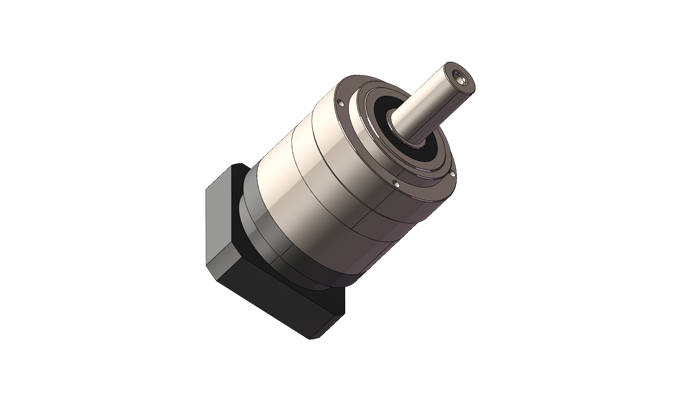
The basic transmission structure of a planetary reducer mainly consists of four core components: planetary gears, sun gears, internal gear rings, and output shafts. It uses planetary gears to achieve the unique working effect of power distribution and multi-tooth meshing.
Features of Planetary Reducers
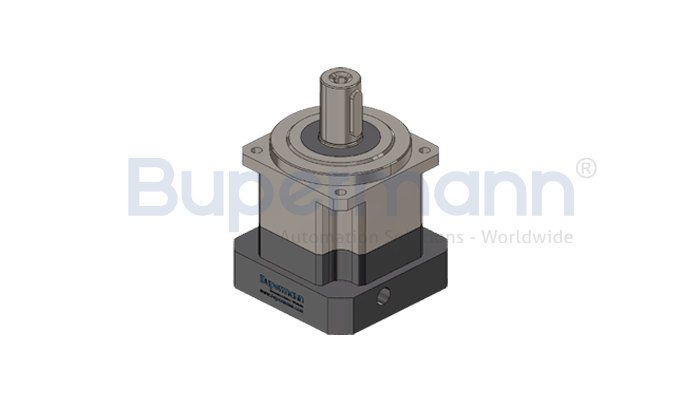
Planetary reducers feature high rigidity, low backlash, high efficiency, high torque, various working conditions, and lifetime maintenance-free operation. Planetary reducers are mostly installed on servo motors and stepper motors. Their functions are: to reduce the rotational speed, increase the torque and match the inertia.
Classification by Gear Structure
1. Straight-tooth Planetary Reducers:
The internal sun gear, planetary teeth, and internal gear ring are all straight-tooth meshing.
2. Helical Planetary Reducers:
The internal sun gear, planetary teeth and internal gear ring are all helical meshing.
Precision Analysis
Spur Gear Planetary Reducers:
P2 grade precision: ≤10 arc minutes
P1 grade precision: ≤6 arc minutes
Helical Planetary Reducers:
P2 grade accuracy: ≤5 arc minutes
P1 grade accuracy: ≤3 arc minutes
P0 grade accuracy: ≤1 arc minute
Transmission Torque and Efficiency
Spur Gear Planetary Reducers:
With the same motor input shaft, straight gears engage, and the rated torque is smaller than that of helical gear planetary reducers, resulting in lower efficiency.
Helical Planetary Reducers:
With the same motor input shaft, helical teeth engage, the rated torque is larger than that of straight planetary reducer, the transmission system is stable, the compressive strength is high, and the efficiency is high.
Structural Differences
The planetary carrier of helical gear planetary reducers must be supported by a double-support structure to be supported, while the planetary carrier of spur gear planetary reducers can be either single-supported or double-supported. The double-supported helical gear planetary reducer is superior to the single-supported straight gear planetary reducer in terms of precision, noise, backlash and service strength.
Advantages and Disadvantages
Advantages of Spur Gears:
Wide range of transmission ratios
Easy processing
Low cost
Disadvantages of Spur Gears:
Mainly, they cause vibration
Whether due to design, manufacturing or deformation reasons, some changes in the shape of the involute may occur along the entire tooth surface at the same time
This will lead to a regular vibration, once per tooth, which is often very intense. The resulting vibration not only causes a large load on the gears but also generates noise
Also, during the contact time, the additional strength sometimes obtained from the meshing of two pairs of teeth cannot be utilized because the stress is limited by the condition of single-tooth meshing in the cycle
It can only withstand radial loads but not axial loads, resulting in an unreasonable load distribution and reducing the overall service life of the gearbox
There is only one support point. When it is subjected to force, the gear will deflect to the other side, the noise will rise, the friction will increase, excessive force will cause deformation, and over time, its strength will deteriorate and the accuracy will be reduced
Advantages of Helical Gears:
The output shaft is an integrated double-support structure, with the bearing and the output shaft being integrated. Each hole on the output shaft corresponds up and down precisely and accurately, without any deviation
Helical tooth type structure precision reducer, high torque, high rigidity, high-precision output (high efficiency and low noise), low backlash, and high positioning accuracy
Disadvantages of Helical Gears:
They are more difficult to process
Have higher requirements for machine tools
Are more expensive than straight gears